
White Label Portal
Launch a fully branded, turnkey portal with enrollment and monitoring live in days.
Learn moreAchieve strategic balance by leveraging the low-overhead efficiency of the White-Label Portal for complex functions, while utilizing the API for embedding real-time, mission-critical data flows into your native UX.

The Hybrid Model is the most flexible and strategically sound deployment pathway, designed for partners who require immediate time-to-value while preserving a long-term roadmap for deep integration. This architecture allows your organization to segment operational responsibilities based on complexity and available engineering bandwidth.

Launch quickly with the full functionality of the Portal, then incrementally introduce API integration for core features as your internal product development capacity matures.

Utilize the Portal for high-overhead, low-frequency tasks, such as managing the user's secure restoration case file or handling legal disclosures.

Reserve API integration exclusively for critical, real-time consumer-facing moments where native application control is mandatory—like embedding a status widget or performing a real-time credential check at login.

Maximizes development resources by eliminating the need to build and maintain the entire front-end infrastructure for complex compliance-heavy modules.
Integrated Architectural
Components
The Hybrid structure ensures that the Portal and API layers function as one cohesive service:
The Hybrid structure ensures that the Portal and API layers function as one cohesive service:
The Hybrid Model is the most strategically astute deployment choice for partners with dynamic roadmaps and demanding operational requirements:
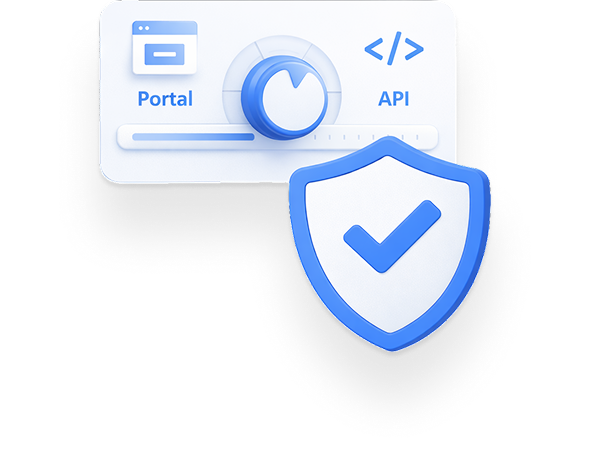
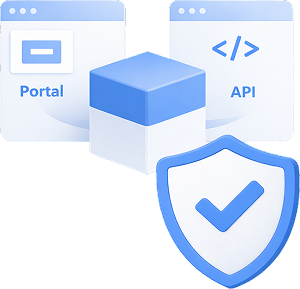
The architecture is governed by shared services, ensuring data integrity and seamless function regardless of the user's current interface layer:
Unified Identity Plane: The solution operates on a shared back-end of core services and data stores. This unified identity plane ensures functional consistency and data synchronization, irrespective of whether the feature is consumed via the Portal front end or an API endpoint.
Component-Level Routing: Allows for granular, capability-specific routing. The partner decides where each module is deployed: for example, restoration case file management is routed to the Portal for secure documentation, while real-time monitoring alerts are ingested via API for native application presentation.
Session Management & SSO: Maintains a seamless, low-friction user hand-off between the native application and the Portal via the SSO Bridge. This guarantees session continuity and consistent authentication (SAML/OIDC) across both application surfaces.
Consolidated Reporting Telemetry: All operational data, including enrollment rates, alert volume, and restoration case statuses, is aggregated into unified reporting dashboards. Data exports are available from both the Portal and API layers, ensuring complete and auditable visibility.
Launch a fully branded, turnkey portal with enrollment and monitoring live in days.
Learn more
Embed protection natively into your product with modular REST endpoints and full UX ownership.
Learn more
Unified Surface, Deep, and Dark Web monitoring with AI-correlated, analyst-verified alerts.
Learn more
U.S.-based specialists lead identity restoration end to end, backed by up to $5M coverage.
Learn more